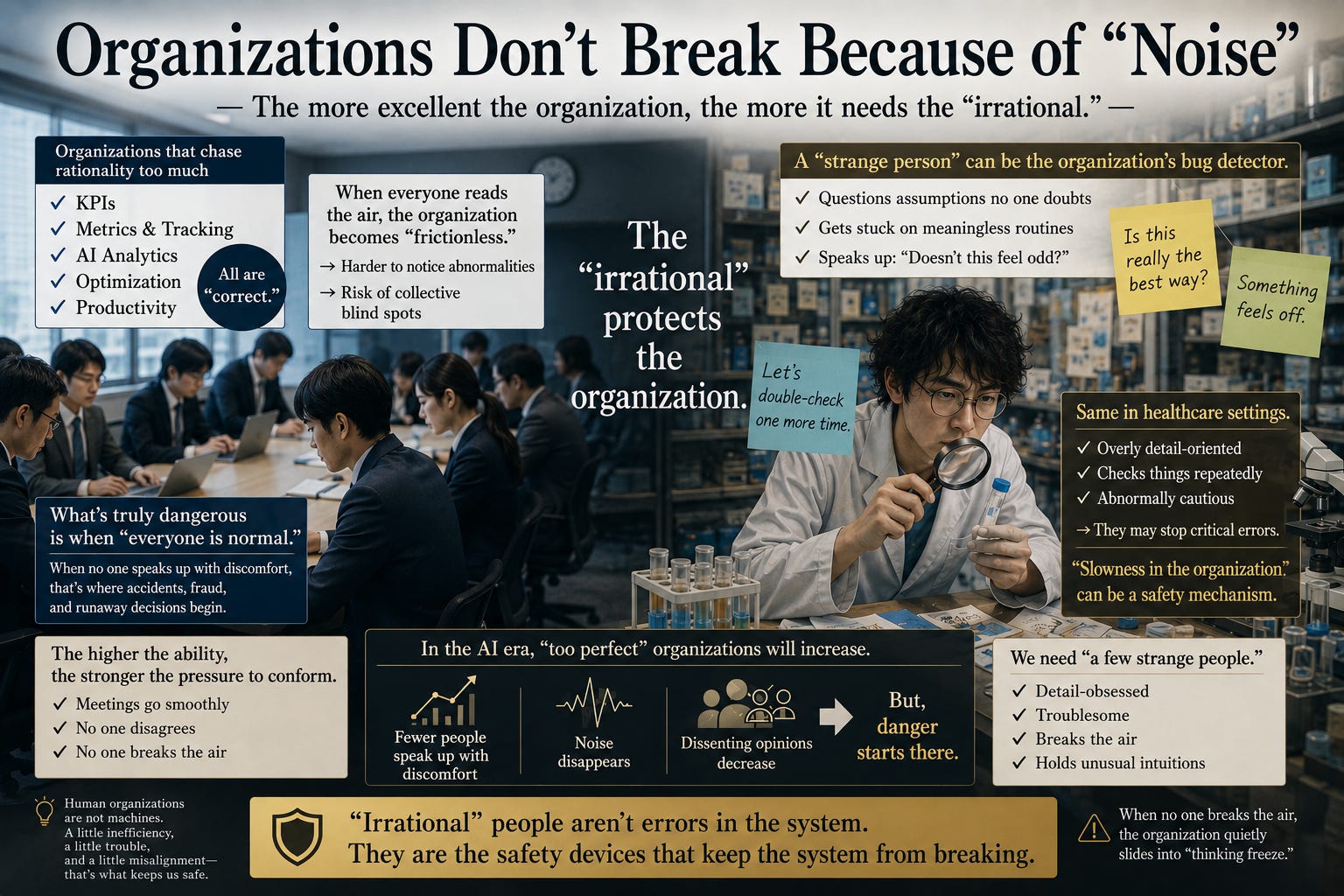
On the quiet utility of people who never quite fit in
There is someone at almost every workplace who makes you pause, briefly, and wonder how they ended up there.
You know the type. They ask too many questions in meetings that everyone else wants to end. They take twice as long to finish things — not out of laziness, but out of some internal compulsion to check again. They say that seems a little off to me in a room full of people who have already moved on.
For a long time, I watched these people with a kind of low-grade puzzlement. In a field like laboratory medicine, where precision matters and protocol is everything, the slow ones and the stubborn ones can feel like friction in an otherwise smooth machine.
I've started to think differently about that friction.
The organization that optimized itself
Modern institutions love efficiency. They love KPIs and dashboards and the clean satisfaction of a process that runs without resistance. And in many ways, this is good — waste is waste, delay is delay.
But there is a side effect that rarely gets discussed. When you optimize hard enough, you begin to select against unpredictability. You start, without intending to, to sort out the people who break the rhythm.
The people most likely to flag an error are often the same ones who slow everything down. It is not despite their friction — it is because of it.
The counterintuitive thing is this: the more competent an organization becomes, the more dangerous this sorting gets.
When everyone reads the room
Highly capable people are, almost by definition, good at adapting. They pick up on what's expected. They know when to push and when to let it go. In a well-run organization, they learn quickly that certain questions aren't really welcome — not because anyone said so, but because the air in the room made it clear.
Meetings flow without interruption. Decisions get made. Nothing scrapes.
The organization becomes frictionless. And frictionless, it turns out, is another word for unable to feel when something is wrong.
This is the part that kept nagging at me. In clinical settings, there is a term for what happens when everyone defers to the prevailing interpretation of a test result: anchoring. You see what you expect to see. The outlier that should have made someone pause gets smoothed over, absorbed into the consensus.
The person who says but wait is not a nuisance. They are the system catching itself.
What I've seen at the bench
There is a colleague I've worked near for years. She verifies things everyone else has already verified. She will re-read a requisition that two other people have already cleared. Early on, this struck me as a kind of anxious redundancy.
Then one afternoon she caught a sample mislabeling that had made it through two checkpoints. The kind of error that, downstream, could have been serious. She did not catch it through superior intelligence or special training. She caught it because she had not yet decided that it was fine.
I think about that often.
In laboratory work, a small delay caused by one careful person can prevent an outcome that costs far more than the time lost. The slowness is not waste. It is margin.
The AI problem on the horizon
I find myself thinking about this more as automation moves deeper into organizational life. AI systems are extraordinarily good at pattern recognition, optimization, and producing outputs that look clean and confident. They do not hesitate. They do not double-check from a place of vague unease.
The organizations building around these tools will, I suspect, become even more efficient at removing the rough edges. Humans who match the pattern will be valued. Humans who introduce noise will be harder to justify.
What disappears first, in that world, is the person who says something feels off before they can even explain why.
The danger isn't a rogue algorithm. It's a room where no one is left who would think to question one.
On the necessity of the ill-fitted
I am not making a sentimental case for incompetence. There is a real difference between someone who slows things down out of skill and someone who does so out of indifference.
What I am suggesting is something more specific: that organizations need people who have not fully surrendered their discomfort. People for whom something can still feel wrong even when everyone around them has decided it's fine. People who haven't learned — or have stubbornly refused to learn — to read the room so well that they stop reading the situation.
These are not easy colleagues. But they are, I think, a kind of institutional immune system. And immune systems are never comfortable to have. They produce inflammation. They slow the body down. That is rather the point.
The silence before the failure
If I had to name one warning sign — in a hospital, a company, a government body, anywhere — it would not be the presence of difficult people. It would be their absence.
The moment when every meeting ends without anyone looking uncertain. When new directions are accepted with immediate enthusiasm. When the air in the room is clean and easy and no one has broken it in months.
That is when I would start to worry.
Not because something has necessarily gone wrong yet. But because the thing that would have noticed — and said so — has quietly been removed.
Is there something you've noticed recently — at work, in a system, in daily life — that seemed slightly off, but that no one around you appeared to register? Margin Archive collects these observations. Leave a note in the comments, or find us at X: @Margin_Archive.
Also from Margin Archive (Japanese)
Book
Margin Archive — English edition (Amazon Japan)